
Rebuilding Human Beings in an Age of Fragmentation.
Human beings today are living in one of the most materially advanced civilizations in history, yet beneath this extraordinary progress lies a silent emotional, psychological, relational, and existential crisis that modern society rarely pauses long enough to examine honestly.
Never before have people possessed such convenience and yet felt so internally burdened. Never before has humanity had such access to information while simultaneously struggling so deeply with confusion, anxiety, distraction, loneliness, impulsivity, emotional instability, and loss of meaning.
Modern civilization has become remarkably efficient at stimulating the human mind, but increasingly ineffective at nourishing the human spirit.
We have learned how to extend lifespan, but not necessarily how to deepen life. We know how to accelerate productivity, but not how to cultivate inner peace. We know how to remain digitally connected, but many no longer know how to remain emotionally connected — to themselves, to their families, or to the deeper principles that sustain human flourishing.
The modern human being often lives in a state of continuous fragmentation.
Attention is fragmented.
Relationships are fragmented.
Identity is fragmented.
Families are fragmented.
Health is fragmented.
Values are fragmented.
The nervous system itself has become fragmented under relentless stimulation, stress, comparison, fear, and emotional overload.
This fragmentation has consequences.
It appears in the rising epidemic of anxiety disorders, depression, burnout, chronic stress, sleep disturbances, addiction, emotional reactivity, obesity, loneliness, relationship breakdown, purposelessness, and increasing emotional fragility across generations. Many individuals are surviving externally while collapsing internally.
The central problem of modern life is not merely stress or technology or social media or unhealthy lifestyles in isolation. These are symptoms of something deeper.
The deeper crisis is disconnection from the principles that govern healthy human living.
Human beings are not machines designed only for productivity and consumption. They are biological, emotional, psychological, relational, moral, and meaning-seeking beings simultaneously. When these dimensions fall out of alignment, suffering emerges — sometimes emotionally, sometimes behaviorally, sometimes relationally, and often physically.
The philosophy of Whole Living begins with a simple but profound recognition:
A meaningful life cannot be built accidentally.
Human beings do not drift naturally toward wholeness. Left unconscious, the human mind drifts toward impulsivity, distraction, emotional reactivity, comparison, fear, avoidance, short-term gratification, tribal thinking, and psychological conditioning shaped by environment rather than wisdom.
To live well therefore requires conscious construction.
It requires awareness.
It requires principles.
It requires emotional maturity.
It requires discipline.
It requires reflection.
It requires responsibility.
It requires meaning.
It requires alignment between one’s biology, values, behavior, relationships, habits, and purpose.
Whole Living is therefore not perfectionism.
Perfectionism itself often emerges from insecurity, fear, shame, or unhealthy societal expectations. Whole Living is not about becoming flawless. It is about becoming integrated.
A whole human being is not someone without pain, weakness, or suffering. A whole human being is someone whose inner life is aligned rather than divided.
Alignment between thought and action.
Alignment between values and behavior.
Alignment between ambition and emotional health.
Alignment between freedom and responsibility.
Alignment between outer success and inner peace.
The philosophy of Whole Living rejects the modern illusion that human fulfillment can be achieved merely through achievement, wealth, pleasure, status, stimulation, or external validation. While these may provide temporary satisfaction, they rarely create enduring psychological stability or deep meaning.
Pleasure entertains.
Meaning sustains.
Modern culture frequently conditions individuals to chase intensity rather than depth. The nervous system becomes addicted to stimulation — notifications, scrolling, consumption, emotional drama, comparison, outrage, instant gratification, constant activity. Yet overstimulation slowly weakens the human capacity for stillness, reflection, focus, emotional regulation, and self-awareness.
A distracted mind becomes vulnerable to manipulation.
When human beings stop consciously choosing their values, society chooses values for them — often through media, algorithms, peer pressure, consumerism, ideology, fear, and unconscious imitation. People begin living reactively rather than intentionally. Identity becomes externally constructed rather than internally cultivated.
The philosophy of Whole Living therefore places great importance upon conscious awareness.
Awareness is the foundation of transformation.
A person cannot regulate emotions they do not recognize.
Cannot heal wounds they do not acknowledge.
Cannot change patterns they do not observe.
Cannot build meaning while living unconsciously.
Self-awareness allows human beings to interrupt automatic reactions and begin living deliberately rather than mechanically.
This philosophy also recognizes that the nervous system plays a central role in human behavior.
Many people believe their struggles are purely moral or motivational failures, when in reality their biology has been chronically shaped by stress, fear, emotional suppression, sleep deprivation, trauma, overstimulation, unhealthy habits, and unresolved emotional experiences. Chronic stress alters cognition, attention, emotional regulation, immune functioning, digestion, hormonal balance, and behavior itself.
The body remembers prolonged emotional states.
A chronically threatened nervous system eventually creates a chronically threatened perception of life.
Thus Whole Living requires biological wisdom.
Sleep matters.
Movement matters.
Nutrition matters.
Recovery matters.
Emotional expression matters.
Stillness matters.
Human connection matters.
The human organism cannot thrive while continuously living in survival mode.
This philosophy also emphasizes the importance of responsibility.
Modern society often confuses freedom with the absence of limits. Yet freedom without responsibility gradually becomes chaos. Human beings flourish not through impulsive living, but through disciplined alignment with principles that protect long-term well-being.
Discipline is not punishment.
It is organized self-respect.
Habits therefore become deeply important because repeated behavior shapes identity. Human beings eventually become what they repeatedly practice emotionally, mentally, physically, relationally, and spiritually.
Thoughts repeated become beliefs.
Beliefs repeated become identity.
Actions repeated become character.
Character repeated becomes destiny.
Whole Living also recognizes that relationships profoundly shape psychological health.
Human beings are relational creatures. Emotional safety, belonging, empathy, trust, validation, healthy boundaries, and meaningful connection regulate the nervous system and deeply influence resilience. Many forms of suffering emerge not merely from external hardship, but from emotional disconnection, unresolved relational wounds, chronic criticism, shame, rejection, neglect, betrayal, or absence of authentic human connection.
Children especially absorb emotional environments long before they intellectually understand them. Parents do not merely raise children through words. They raise children through nervous systems, emotional climates, behavior patterns, and modeled responses to stress and conflict.
The philosophy of Whole Living therefore extends beyond individual success into family systems, parenting, education, and social culture.
A society cannot become emotionally healthy while families remain emotionally unconscious.
Whole Living also places meaning at the center of psychological resilience.
Human beings can endure extraordinary suffering when suffering carries meaning. Without meaning, even comfort becomes empty. Many individuals today are not exhausted because life is difficult alone. They are exhausted because they lack deep purpose, direction, contribution, or connection to something larger than themselves.
Meaning emerges through:
- responsibility,
- growth,
- relationships,
- service,
- contribution,
- integrity,
- and conscious living.
A meaningful life is not necessarily an easy life. Often it requires sacrifice, emotional discomfort, discipline, patience, forgiveness, courage, and maturity. Yet meaning gives suffering psychological direction.
This philosophy finally recognizes that modern society urgently requires a return to principles.
Not rigid dogma.
Not moral superiority.
Not perfectionistic ideology.
But timeless principles rooted in human flourishing.
Truthfulness.
Responsibility.
Compassion.
Self-awareness.
Integrity.
Emotional regulation.
Discipline.
Meaning.
Contribution.
Respect for human dignity.
Conscious parenting.
Wisdom over impulsivity.
Reflection over constant stimulation.
Character over image.
Civilizations weaken when comfort grows faster than character.
The philosophy of Whole Living therefore represents an attempt to rebuild human beings from the inside outward — biologically, emotionally, psychologically, relationally, morally, and existentially.
Not toward perfection.
But toward integration.
Not toward superiority.
But toward maturity.
Not toward temporary motivation.
But toward sustainable transformation.
Because the ultimate goal of life is not merely to accumulate success, survive difficulty, impress society, or avoid suffering.
The ultimate goal is to become fully human.
And perhaps in an age increasingly driven by distraction, emotional reactivity, superficial living, and fragmented identities, choosing to live consciously, responsibly, meaningfully, and wholly may become one of the most necessary acts of our time.
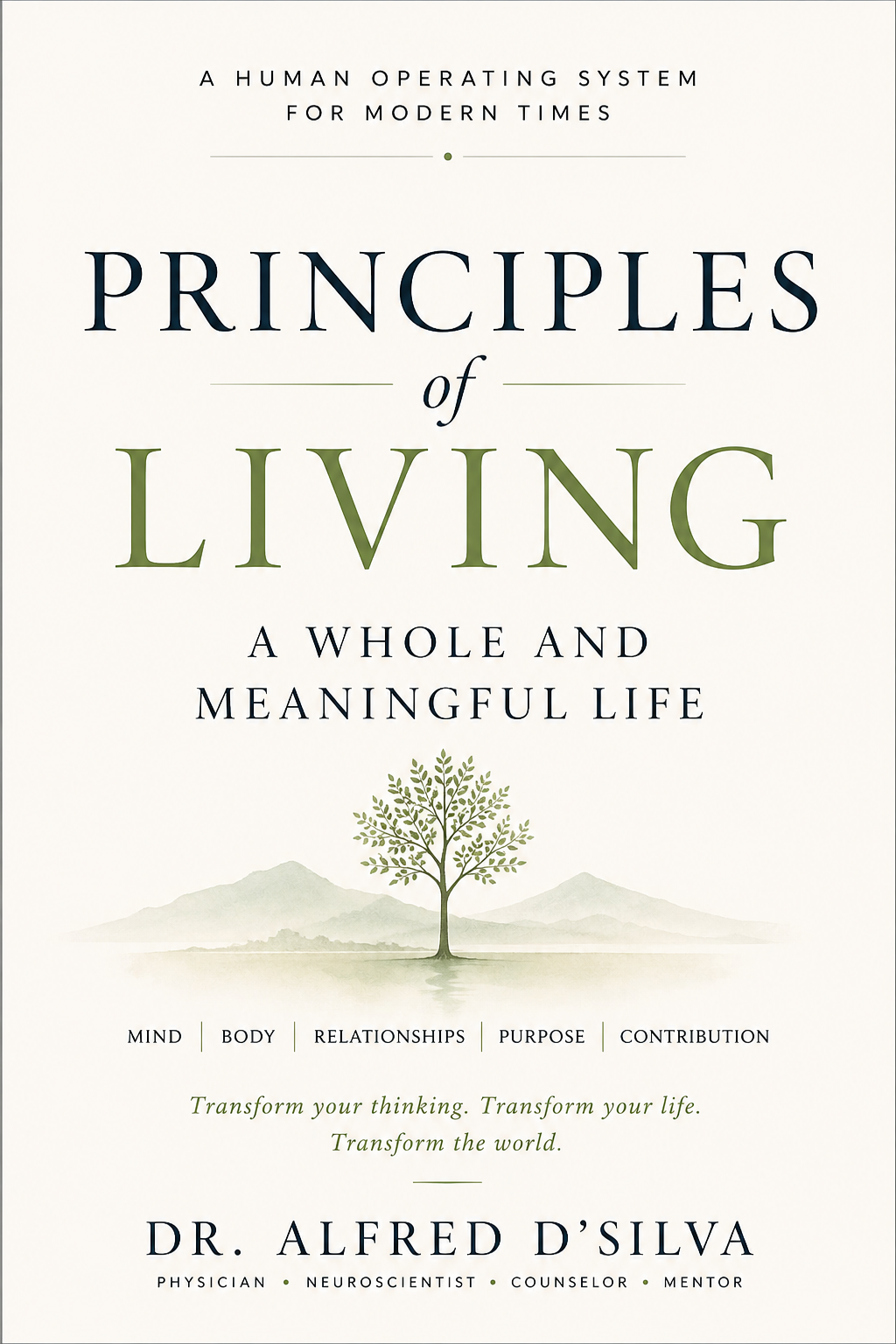
This is a small glimpse of my upcoming book:
Principles of Living a Whole and Meaningful Life: How to Build a Life of Meaning, Integrity, Emotional Strength, and Inner Peace
by Dr. Alfred D’Silva
If you like this article, please leave a comment, it helps and encourages us.
Fill the form below if you wish to own a FREE copy of this book.
Follow us on social media
Share this page on
Read our Latest Post
- Work Burnout: When You’re Tired of More Than Just Work
- Vitamin Deficiency: The Hidden Nutritional Gaps That Can Affect Your Energy, Brain, Immunity and Overall Health
- How to Overcome the Grief of Losing a Parent
- The Twelve Rejections That Changed the World
- Lichen Planus: Understanding the Disease Beyond the Rash
Get in touch with us by filling the form below


Never shy from asking for help
When you face an issue ask for help. you are not the only one having problems. Everyone faces problems. Don’t need to be embarrassed about it. Ask for help from the people who can help you. Talk to your parents. elders, friends, relatives. or you can talk to us.
Website built with WordPress
Leave a Reply