

Concentration is the cornerstone of learning and success in childhood.
Yet, in today’s world filled with distractions—from gadgets to overwhelming schedules—many children struggle to focus. Helping children improve their concentration isn’t just about discipline; it’s about creating the right environment, teaching the right skills, and being patient.
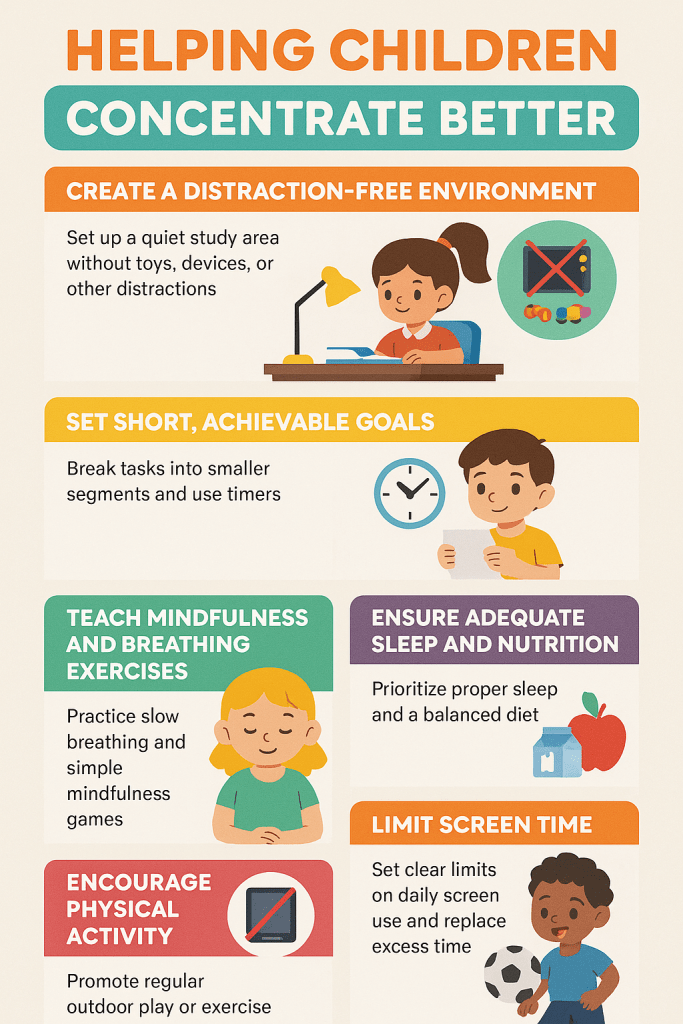
Here’s a comprehensive guide for parents and teachers to help children concentrate better:
1. Create a Distraction-Free Environment
Principle: Children concentrate better in calm, organized spaces.
Example: A child trying to study in a noisy living room with the TV on will struggle to focus.
Action Tip:
Set up a quiet study corner with minimal noise and clutter.
Keep toys, devices, and unrelated books out of sight during study time.
Story: An 8-year-old named Aarya couldn’t sit still during homework time. Her parents realized she was studying next to her toy shelf and the television. They shifted her to a quiet corner with just a table, chair, and lamp. Her focus improved drastically within a week.
2. Set Short, Achievable Goals
Principle: Small tasks feel manageable and help build attention span gradually.
Example: Instead of asking a child to “study for two hours,” break it down into 15–20 minute tasks.
Action Tip:
Use timers or apps to segment time.
Praise completion of each small goal.
Story: Rahul, a 10-year-old, hated long study sessions. His mother used a kitchen timer and challenged him to finish a math worksheet in 20 minutes, followed by a break. This made study time feel like a game, and he became more motivated.
3. Teach Mindfulness and Breathing Exercises
Principle: Calm minds focus better.
Example: Deep breathing before tasks can help children settle their minds.
Action Tip:
Practice 2–3 minutes of slow breathing before study or homework.
Try simple mindfulness games like focusing on one sound or object.
Story: Tara, a 7-year-old, was easily distracted during class. Her teacher introduced a “calm time” with deep breathing every morning. Over a month, Tara’s ability to stay focused noticeably improved.
4. Ensure Adequate Sleep and Nutrition
Principle: Tired or hungry children find it harder to concentrate.
Example: A child skipping breakfast may feel sluggish and distracted in school.
Action Tip:
Ensure 9–11 hours of sleep (depending on age).
Serve brain-boosting foods: fruits, whole grains, nuts, eggs, and leafy greens.
Story: After addressing poor sleep habits and switching sugary snacks to nuts and fruits, a 9-year-old boy’s teacher reported increased alertness and class participation.
5. Limit Screen Time
Principle: Overexposure to screens reduces attention span.
Example: Children who watch fast-paced cartoons for hours may struggle to stay engaged with slower-paced learning activities.
Action Tip:
Set clear limits on daily screen time.
Replace excess screen use with reading, outdoor play, or crafts.
Story: After reducing her 6-year-old son’s screen time from 4 hours to 1 hour daily, a mother noticed he was more willing to sit with books and puzzles.
6. Encourage Physical Activity
Principle: Active bodies lead to alert minds.
Example: A short outdoor game can refresh a tired brain.
Action Tip:
Ensure at least 1 hour of active play daily.
Include activities like running, jumping, or team sports.
Story: A school found that after introducing 10-minute movement breaks between lessons, students were more attentive and performed better academically.
7. Foster Interest and Curiosity
Principle: Children concentrate more when they are interested.
Example: A child who loves animals will focus longer on a science lesson involving animals.
Action Tip:
Connect learning to the child’s interests.
Use stories, experiments, and visuals to make lessons engaging.
Story: Neha, a 5th grader uninterested in history, began enjoying it once her teacher used stories and animations. Her focus and grades improved significantly.
Final Thoughts
Helping a child concentrate is not about forcing them to sit still but about nurturing their ability to engage meaningfully. With consistency, patience, and empathy, parents and educators can support children in building strong concentration skills—skills that will benefit them throughout life.
Children may forget what you said—but they never forget how you made them feel.
Homoeopathy has many medicines and tonics to improve concentration and memory.
If you need any guidance to better your child’s concentration, feel free to get in touch with us by filling the form below
Follow us on social media
Share this page on
Read our Latest Post
- Overthinking: The Mental Trap That Steals Peace – Why we do it, how it harms us, and what we can do to break free
- ADHD: Not a Lack of Discipline, but a Different Way of Being
- Signs That You Are Ruining Your Relationship – How to recognize harmful patterns before it’s too late
- Why Faithful People Cheat: The Quiet Cracks That Break Relationships—and How to Heal Them
- Why Women Blame Their Husbands for All Their Problems(And what is really going on beneath the surface)
Get in touch with us by filling the form below


Never shy from asking for help
When you face an issue ask for help. you are not the only one having problems. Everyone faces problems. Don’t need to be embarrassed about it. Ask for help from the people who can help you. Talk to your parents. elders, friends, relatives. or you can talk to us.
Website built with WordPress
 Dr. Alfred D'Silva
Leave a comment