

Parenting stubborn children can feel like a daily power struggle. Their firm “no” to every suggestion, refusal to cooperate, or endless negotiation attempts can leave parents feeling helpless or frustrated. However, stubbornness is not necessarily a flaw—it can be a sign of strong will and determination. The key lies in channeling that energy positively while setting healthy boundaries.
Here’s how to understand and deal effectively with stubborn children.
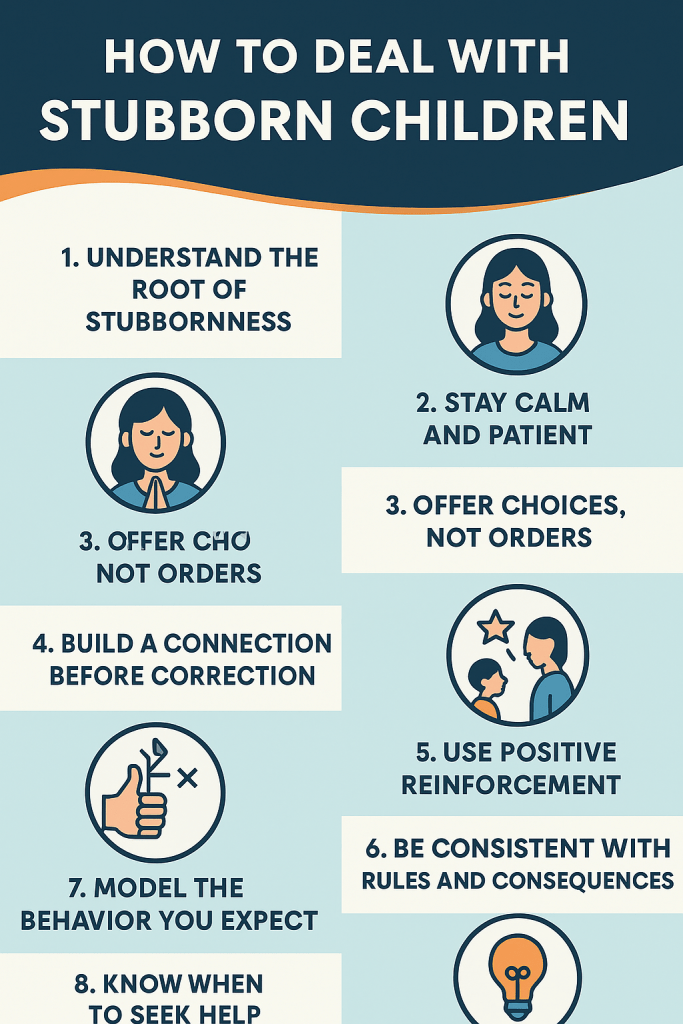
1. Understand the Root of Stubbornness
Stubborn behavior is often a child’s way of asserting independence or expressing unmet needs. Children may resist when:
*They feel unheard or misunderstood
*They lack control over choices
*They are tired, hungry, or overstimulated
*They are naturally strong-willed by temperament
🔹 A 5-year-old refuses to wear the clothes you pick. Instead of a battle, offer a choice between two outfits. Giving them control reduces resistance.
2. Stay Calm and Patient
Reacting with anger or frustration often worsens the behavior. Stubborn children tend to mirror the emotional intensity around them.
✅ What to do: Take deep breaths, keep your voice steady, and avoid yelling. Responding calmly shows them how to regulate emotions.
🟣 Rhea, a mother of a 7-year-old boy, noticed that her son became more cooperative when she stopped shouting and started speaking softly during his meltdowns.
3. Offer Choices, Not Orders
Stubborn children dislike being told what to do. When they feel forced, they resist to maintain control. Instead, involve them in decisions.
🔸 Tip: Use limited choices—“Would you like to do your homework before dinner or after?” This gives them autonomy within boundaries.
4. Build a Connection Before Correction
Children are more likely to listen when they feel connected. Harsh discipline without emotional bonding pushes them away.
💖 Connection tools:
*Spend one-on-one time daily
*Listen without interrupting
*Empathize with their emotions
🟢 “Seek first to understand, then to be understood.” – Stephen Covey
5. Use Positive Reinforcement
Instead of constantly pointing out what your child is doing wrong, praise their good behavior. This encourages repetition.
🌟 Examples of praise:
“I loved how you put your toys away without being asked.”
“Thank you for listening the first time.”
This builds their self-esteem and reduces the need to fight for attention.
6. Be Consistent with Rules and Consequences
Stubborn children will test boundaries. Inconsistency teaches them that persistence might get them what they want.
🛑 Tip: Clearly state the rule and consequence beforehand—and follow through calmly.
🧩 Example: “If you don’t switch off the TV in 10 minutes, there will be no screen time tomorrow.” Stick to it even if there are tears.
7. Model the Behavior You Expect
Children learn more by watching than listening. If they see you being patient, respectful, and calm, they’re more likely to imitate that.
👁️ Be the example: Handle disagreements with grace and avoid arguments in front of them.
8. Know When to Seek Help
Sometimes, stubbornness may stem from deeper issues like anxiety, ADHD, or other emotional difficulties. If the behavior severely affects daily life or relationships, consider consulting a child psychologist or counselor.
Conclusion
Dealing with stubborn children requires a blend of empathy, firmness, and creative communication. With consistency, understanding, and love, parents can help transform stubbornness into strength. Remember, a stubborn child today can become a determined leader tomorrow—if guided with wisdom and patience.
Follow us on social media
Share this post on social media
Latest Post
- Overthinking: The Mental Trap That Steals Peace – Why we do it, how it harms us, and what we can do to break free
- ADHD: Not a Lack of Discipline, but a Different Way of Being
- Signs That You Are Ruining Your Relationship – How to recognize harmful patterns before it’s too late
- Why Faithful People Cheat: The Quiet Cracks That Break Relationships—and How to Heal Them
- Why Women Blame Their Husbands for All Their Problems(And what is really going on beneath the surface)
If you seek guidance with parenting, get in touch with us by filling the form below


Never shy from asking for help
When you face an issue ask for help. you are not the only one having problems. Everyone faces problems. Don’t need to be embarrassed about it. Ask for help from the people who can help you. Talk to your parents. elders, friends, relatives. or you can talk to us.
Website built with WordPress
 Dr. Alfred D'Silva
Leave a comment