

Gentle Discipline That Builds Respect and Responsibility
Yelling may grab attention, but it rarely teaches lessons. More often, it builds fear, resentment, or shame. As parents, we want our children to behave well—not out of fear—but from understanding and self-control. Disciplining without yelling isn’t about being permissive. It’s about teaching with respect, consistency, and emotional intelligence.
Here’s how you can discipline effectively—without raising your voice.
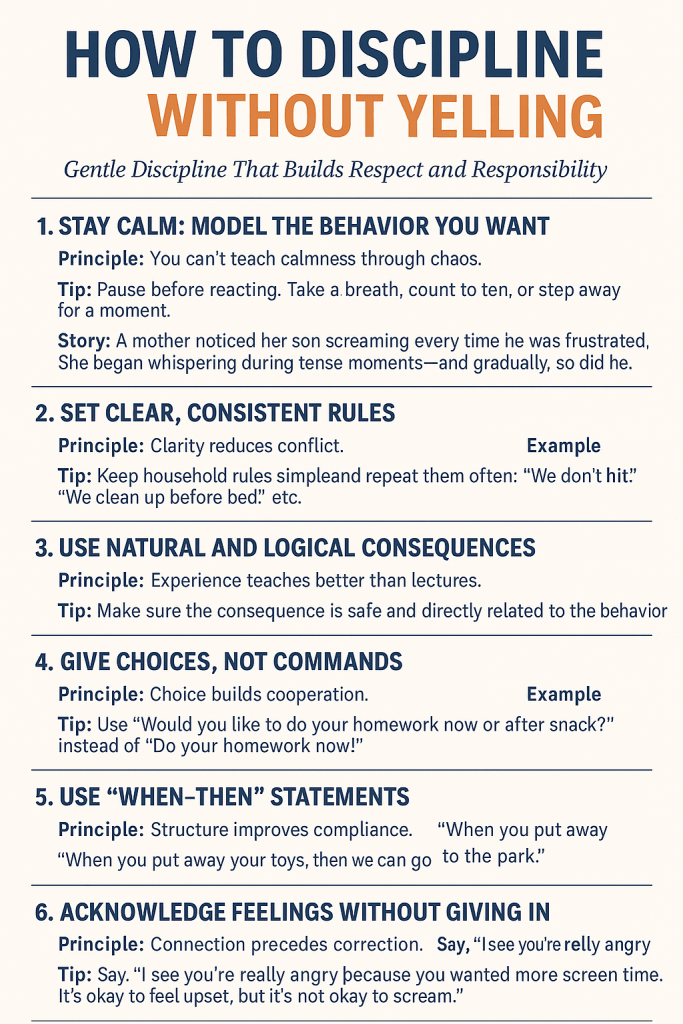
1. Stay Calm: Model the Behavior You Want
Children learn more from what we do than what we say. When we lose control and yell, we teach them to react the same way.
Principle: You can’t teach calmness through chaos.
Tip: Pause before reacting. Take a breath, count to ten, or step away for a moment.
A mother noticed her son screaming every time he was frustrated. She realized it mirrored her own yelling. She began whispering during tense moments—and gradually, so did he.
2. Set Clear, Consistent Rules
Kids thrive on predictability. If rules change often, they feel insecure and test boundaries more.
Principle: Clarity reduces conflict.
Tip: Keep household rules simple and repeat them often: “We don’t hit,” “We clean up before bed,” etc.
Instead of waiting until a child jumps on the sofa to say “Don’t do that!”—establish early: “Sofas are for sitting, beds are for jumping.”
3. Use Natural and Logical Consequences
Rather than punish, let the consequence teach. If your child refuses to wear a raincoat, let them experience a little discomfort from the rain (natural). If they break a toy by throwing it, don’t replace it (logical).
Principle: Experience teaches better than lectures.
Tip: Make sure the consequence is safe and directly related to the behavior.
4. Give Choices, Not Commands
Power struggles often trigger yelling. Offering choices gives children a sense of control.
Principle: Choice builds cooperation.
Tip: Use “Would you like to do your homework now or after snack?” instead of “Do your homework now!”
Example: A child may resist brushing teeth. Offering a choice—“Do you want the blue or red toothbrush?”—redirects resistance into participation.
5. Use “When-Then” Statements
This technique helps set expectations without threats.
Principle: Structure improves compliance.
Tip: “When you put away your toys, then we can go to the park.”
This frames discipline in terms of responsibility and reward, not control.
6. Acknowledge Feelings Without Giving In
Children act out when overwhelmed by emotion. Validating their feelings doesn’t mean accepting bad behavior—it means connecting before correcting.
Principle: Connection precedes correction.
Tip: Say, “I see you’re really angry because you wanted more screen time. It’s okay to feel upset, but it’s not okay to scream.”
7. Use Time-Ins Instead of Time-Outs
Time-outs isolate. Time-ins create space for reflection, not rejection.
Principle: Discipline should guide, not punish.
Tip: Sit with your child and talk through what happened. Let them calm down with you before discussing better choices.
8. Praise Effort, Not Just Outcomes
Catch your child being good. Reinforce the behavior you want to see more of.
Principle: Positive reinforcement works better than punishment.
Tip: “I noticed how you put your shoes away without being asked—that’s responsible!”
Conclusion
Yelling may feel effective in the moment, but it erodes trust over time. Discipline is about teaching, not punishing. With patience, empathy, and consistency, you can raise a child who listens—not out of fear—but because they understand and respect the boundaries you’ve set.
Follow us on social media
Share this page on
Read our Latest Post
- Overthinking: The Mental Trap That Steals Peace – Why we do it, how it harms us, and what we can do to break free
- ADHD: Not a Lack of Discipline, but a Different Way of Being
- Signs That You Are Ruining Your Relationship – How to recognize harmful patterns before it’s too late
- Why Faithful People Cheat: The Quiet Cracks That Break Relationships—and How to Heal Them
- Why Women Blame Their Husbands for All Their Problems(And what is really going on beneath the surface)
If you need any advice on how to deal with your child, get in touch with us by filling the form below


Never shy from asking for help
When you face an issue ask for help. you are not the only one having problems. Everyone faces problems. Don’t need to be embarrassed about it. Ask for help from the people who can help you. Talk to your parents. elders, friends, relatives. or you can talk to us.
Website built with WordPress
 Dr. Alfred D'Silva
Leave a comment