

In the journey of parenting, one of the greatest gifts you can offer your child is not wealth, fame, or status—it is self-confidence. A confident child grows into a capable adult who dares to dream, tries new things, and copes with life’s ups and downs. Yet, building self-confidence is one of the most misunderstood and challenging tasks for parents.
Let’s explore this vital parenting challenge and how to address it wisely.
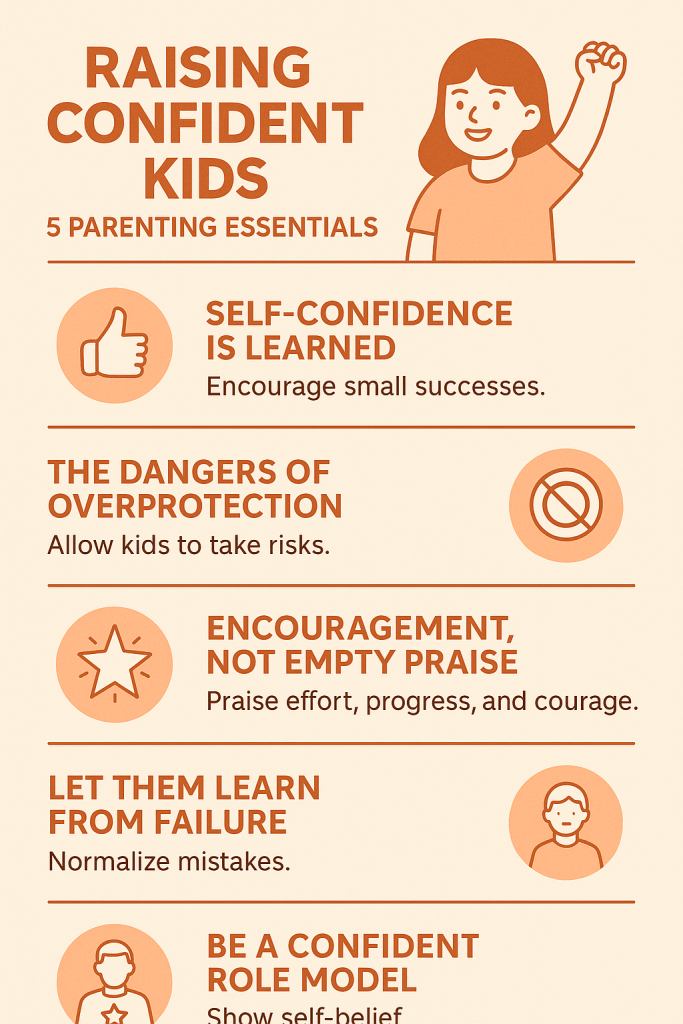
1. Self-Confidence Is Learned, Not Inborn
Principle: Confidence grows from small successes and positive reinforcement.
Children are not born confident. They develop self-belief by taking risks, making mistakes, learning, and feeling capable.
A shy boy refused to speak in class fearing embarrassment. His mother encouraged him to read aloud at home in front of family. Slowly, his fear reduced, and he participated in a school skit. His small success built lasting confidence.
Lesson: Break big tasks into small achievable steps. Celebrate each little success.
2. The Dangers of Overprotection
Principle: Too much protection limits confidence.
Parents who overprotect out of fear—“Don’t climb, you’ll fall!” or “Let me do this for you”—send the message that the child is not capable. This weakens self-trust.
A girl whose mother constantly did her homework struggled in college to complete assignments independently. Her self-doubt stemmed from years of being “rescued” by adults.
Lesson: Let children face manageable risks and solve problems by themselves.

3. Encouragement, Not Empty Praise
Principle: Praise effort, progress, and courage—not just talent.
Telling children “You’re perfect” or “You’re the best” can create pressure to live up to impossible standards. Instead, praise specific effort: “You worked hard to finish this puzzle” or “I admire how you didn’t give up.”
A boy praised only for his intelligence panicked when he got a low score. After his parents shifted to praising effort (“You tried new ways to solve this”), he handled failure better and stayed motivated.
Lesson: Focus on process praise—not person praise.
4. Let Them Learn from Failure
Principle: Failure is not the end—it is the beginning of growth.
Fear of failure kills confidence. Children must be taught that mistakes are normal and useful.
A teenager lost a school debate. Instead of scolding, her father discussed what went wrong and how she could improve. She tried again and won the next event. Her confidence doubled.
Lesson: Respond calmly to your child’s failures. Teach them to analyze and learn—not fear.
5. Be a Confident Role Model
Principle: Children learn confidence by watching their parents.
If you doubt yourself, criticize yourself, or fear risks openly, children absorb the same habits. Show confidence, resilience, and positive self-talk in your own life.
A mother trying public speaking despite nervousness inspired her daughter to audition for a play. Seeing a parent stretch their comfort zone teaches bravery.
Lesson: Demonstrate self-belief through your own actions.
Conclusion: Confidence is the Foundation for Life
Self-confidence does not come from protection, perfection, or praise alone. It grows from experience, effort, resilience, and belief in one’s own ability.
✔️ Let them try—and fail.
✔️ Praise effort and courage.
✔️ Teach problem-solving.
✔️ Model confidence yourself.
When you build your child’s confidence, you equip them not just for school—but for life.
(Keep reading the following 6 post as a continuation of this article in which I describe each of the 12 challenges in detail.)
Follow us on social media
Share this page on
Read our Latest Post
- Overthinking: The Mental Trap That Steals Peace – Why we do it, how it harms us, and what we can do to break free
- ADHD: Not a Lack of Discipline, but a Different Way of Being
- Signs That You Are Ruining Your Relationship – How to recognize harmful patterns before it’s too late
- Why Faithful People Cheat: The Quiet Cracks That Break Relationships—and How to Heal Them
- Why Women Blame Their Husbands for All Their Problems(And what is really going on beneath the surface)
Get in touch with us by filling the form below


Never shy from asking for help
When you face an issue ask for help. you are not the only one having problems. Everyone faces problems. Don’t need to be embarrassed about it. Ask for help from the people who can help you. Talk to your parents. elders, friends, relatives. or you can talk to us.
Website built with WordPress
 Dr. Alfred D'Silva
Leave a comment