

In today’s competitive world, parents often find themselves walking a tightrope between encouraging academic success and protecting their child’s mental well-being. Academic pressure has silently become one of the most difficult parenting challenges of this era—often unnoticed until it turns into anxiety, low self-esteem, or even depression in children.
Let’s explore why this happens, and how parents can wisely and sensitively handle this challenge.
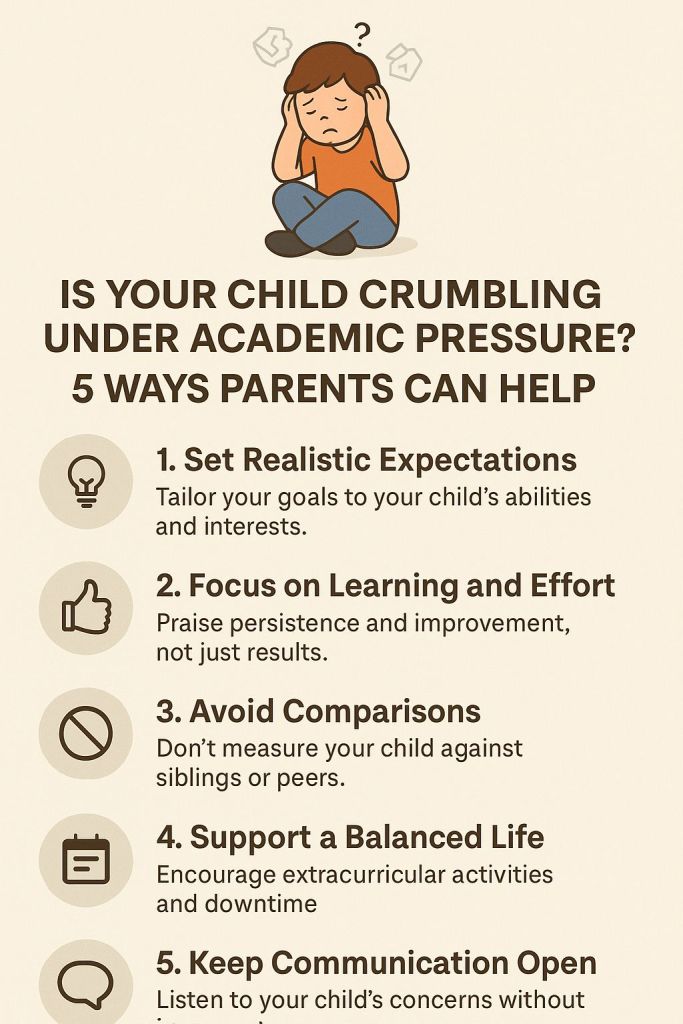
1. The Root of Academic Pressure: Expectations vs Reality
Principle: Set realistic and personalized expectations for your child.
Many parents want the best for their children: top ranks, entrance to prestigious institutions, or mastering multiple skills. However, when these desires become expectations detached from the child’s capability or interest, pressure builds.
Example:
A mother insisted that her son become an engineer like his father, despite his passion for music. As his grades dropped in math and physics, arguments and scolding became frequent at home, making him anxious and withdrawn. When they finally acknowledged his love for music and enrolled him in a music course, his confidence returned, and even his academic performance improved.
Lesson: Understand your child’s uniqueness. Not every child is meant to shine in the same area.
2. Fear of Failure: A Silent Stress Builder
Principle: Focus on learning and effort—not just results.
When parents reward only marks and ranks, children start associating love and approval with performance. This fear of failure can crush their curiosity and creativity.
Example:
A bright 8th-grader, repeatedly topping his class, broke down during final exams because he feared disappointing his parents if he didn’t score the highest. After counseling, his parents realized they rarely praised his effort and progress—they only celebrated his results. They consciously changed their feedback approach to encourage effort and learning. The boy’s anxiety reduced significantly.
Lesson: Praise persistence, improvement, and hard work rather than only the outcome.
3. The Comparison Trap: Sibling and Peer Pressure
Principle: Never compare your child to others.
Comparing your child to neighbors, cousins, or classmates damages self-worth. Every child blooms at their own pace.
Example:
A father frequently compared his daughter’s grades to her high-scoring cousin. The result? The girl developed inferiority complex and stopped participating in school competitions. When the father stopped comparing and encouraged her interests in literature, she started excelling in writing contests.
Lesson: Let your child compete with themselves—not others.
4. Balancing Academics with Life Skills
Principle: Life is more than textbooks.
Overemphasis on academics often sidelines essential life skills like emotional intelligence, problem-solving, or resilience.
Example:
A high-achieving student aced exams but struggled during college interviews because he lacked communication skills and confidence. His parents realized they had focused only on marks, ignoring other dimensions of his growth.
Lesson: Support extracurricular activities, hobbies, and social learning equally.
5. Open Conversations: The Stress Buster
Principle: Create a safe space for your child to express academic fears.
Children hesitate to share their struggles when they fear punishment or ridicule.
Example:
One mother noticed her daughter hiding her low math scores. Instead of scolding, she gently asked why. The daughter confessed she couldn’t understand the new concepts but was scared to admit it. The mother hired a tutor, and the daughter’s confidence soared.
Lesson: Be approachable. Listen without judging.
Conclusion: The Gentle Push, Not the Crushing Pressure
Academic success is important—but not at the cost of your child’s mental health or happiness. As parents, your role is to guide, encourage, and support—not demand perfection.
Remember:
✔️ Value effort over outcome.
✔️ Encourage individuality.
✔️ Balance studies with life skills.
✔️ Keep communication open.
Your child’s well-being is the foundation on which true academic and life success is built.
(Keep reading the following 8 post as a continuation of this article in which I describe each of the 12 challenges in detail.)
Follow us on social media
Share this page on
Read our Latest Post
- Overthinking: The Mental Trap That Steals Peace – Why we do it, how it harms us, and what we can do to break free
- ADHD: Not a Lack of Discipline, but a Different Way of Being
- Signs That You Are Ruining Your Relationship – How to recognize harmful patterns before it’s too late
- Why Faithful People Cheat: The Quiet Cracks That Break Relationships—and How to Heal Them
- Why Women Blame Their Husbands for All Their Problems(And what is really going on beneath the surface)
Get in touch with us by filling the form below


Never shy from asking for help
When you face an issue ask for help. you are not the only one having problems. Everyone faces problems. Don’t need to be embarrassed about it. Ask for help from the people who can help you. Talk to your parents. elders, friends, relatives. or you can talk to us.
Website built with WordPress
 Dr. Alfred D'Silva
Leave a comment